
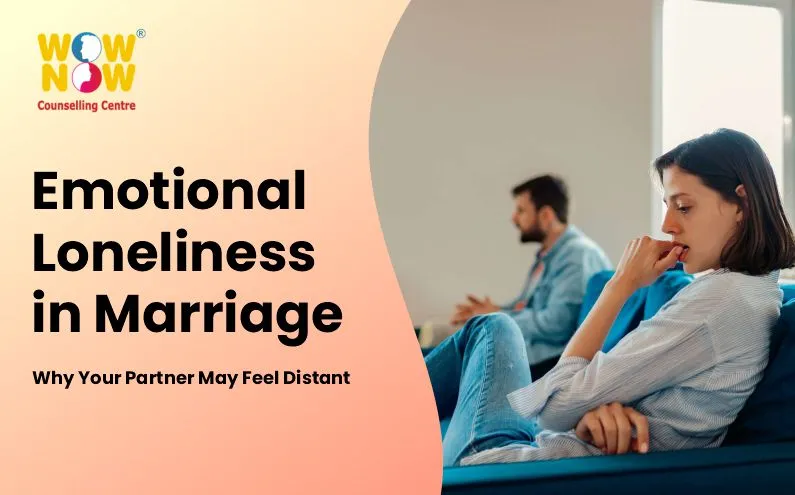
Emotional Loneliness in Marriage: Why Your Partner May Feel Distant
Emotional loneliness in marriage is the feeling of being alone while sharing a home, a bed and a daily routine with your spouse. You may run the household, raise children and attend family functions together, yet feel that nobody understands what is happening inside you. Physical togetherness and emotional connection are different things, and a marriage can have plenty of the first with very little of the second. Emotional distance also does not mean your partner has stopped caring. Work pressure, parenting duties, family expectations and unspoken hurts can pull two committed people apart without either of them intending it.
This article explains what emotional loneliness in marriage means, how to recognise its signs, why a partner may seem distant and how distance affects intimacy. It also covers practical ways to reconnect and when marriage counselling may help.
What Is Emotional Loneliness in Marriage?
Emotional loneliness in marriage is a lasting sense of being unseen, unheard or unsupported by your spouse, even though you live together and share responsibilities. Feeling lonely in marriage has little to do with how often you are in the same room. It depends on whether you feel known, valued and safe enough to share your thoughts, worries and joys.
Loneliness in a relationship can sit quietly beside a functional routine. Bills get paid, meals get cooked and social obligations get met. The emotional layer, where partners share fears, disappointments and small daily feelings, can thin out without any dramatic event.
How Is Emotional Distance Different From Stress, Neglect or Physical Separation?
These terms overlap, but they are not the same.
- Physical separation means partners live apart or spend long periods away, for example because of work postings.
- Temporary stress is a short phase, such as an exam season, a job change or a family illness, when partners have less energy for each other.
- Emotional distance in marriage is a continuing gap in closeness, whatever the cause.
- Emotional neglect in marriage means one partner’s emotional needs go consistently unmet or ignored over time.
Distance often arises without anyone intending harm, so it does not automatically count as neglect. Differences in emotional expression also matter. One spouse may show care through practical help, while the other needs spoken reassurance. Neither style is wrong, but the mismatch can leave both partners feeling unappreciated.
Can You Feel Lonely in a Happy Marriage?
Yes. Many people describe their marriage as stable, respectful and even affectionate, and still feel lonely in specific ways. They may lack someone to talk to about their inner worries, or feel that conversations stay on schedules and chores. A marriage can be good in many respects and still have unmet emotional needs.
What Are the Signs of Emotional Loneliness in a Marriage?
The main signs of emotional loneliness in marriage include feeling unheard, having few meaningful conversations, receiving little emotional support, carrying unresolved disagreements and feeling increasingly isolated. Signs of emotional loneliness in marriage often build slowly, which makes them easy to dismiss as “just a busy phase.”
Look for patterns such as these:
- You talk mostly about logistics, children, money and household tasks.
- You hesitate to share worries because you expect a dismissive or distracted reaction.
- You feel unheard in the relationship, even when you speak clearly.
- You feel more understood by friends, colleagues or relatives than by your spouse.
- Old arguments stay unresolved, so both of you avoid sensitive topics.
- You feel disconnected from your spouse even during family outings or festivals.
How Do You Know Whether Your Partner Is Emotionally Distant?
An emotionally distant partner may seem preoccupied, give short answers, avoid discussing feelings or withdraw during disagreements. Treat these as observations rather than conclusions. One sign alone does not prove neglect, loss of love or any other hidden problem. Your partner may also feel lonely and distant from you, and may be experiencing the same gap from the other side. The most reliable way to understand what is happening is a calm, honest conversation, which later sections describe.
Why Does Your Partner Feel Emotionally Distant?
Partners usually grow distant because of stress, tiredness, communication habits, unresolved conflict and changing expectations, not because love has disappeared. If you keep asking “why does my partner feel distant,” remember that you cannot read their mind. Possible explanations are not confirmed causes, and several may act together.
Common contributing factors include:
- Work pressure and long commutes. In busy cities, people often reach home with little energy left for meaningful talk.
- Emotional exhaustion. A partner who is overwhelmed may withdraw to cope, and that withdrawal can look like indifference.
- Parenting and household duties. Many couples spend years in “project management mode,” where every conversation is about the children’s needs.
- Extended family expectations. Responsibilities towards parents, in-laws and relatives can leave little private time, and couples may feel they cannot discuss family tensions openly.
- Communication habits. Criticism, sarcasm, defensiveness or long silences teach both partners that honesty is risky.
- Unresolved conflict. Hurts that never get addressed tend to harden into emotional walls.
- Changing expectations. People change across years of marriage, and the relationship may not have adjusted to who each person has become.
These are among the most common reasons couples grow emotionally apart. Family structures differ widely across Indian households, so not every couple will recognise every factor.
Why Do I Feel Lonely in My Marriage While My Spouse Seems Fine?
Partners often experience the same marriage differently. One may sense distance strongly while the other considers the relationship steady and comfortable. Neither perception is false. The gap itself is the issue, and it only closes when both people hear each other’s experience.
Why Does My Spouse Avoid Emotional Conversations?
Avoidance often has less to do with the relationship than with habit or fear. Some people grew up in homes where feelings were rarely discussed. Others worry that talking about a problem will start an argument. Some simply lack the words for what they feel. Questions such as “why does my husband feel emotionally distant” or “why does my wife feel emotionally distant” rarely have gender-based answers. Any spouse can withdraw, and any spouse can feel left out.
How Does Emotional Distance Affect Marriage and Emotional Intimacy?
Persistent emotional distance can weaken trust, reduce closeness, make communication harder and lower relationship satisfaction. Lack of emotional intimacy in marriage rarely stays contained. When partners stop sharing small moments, they gradually stop sharing larger ones.
Research on couple interaction explains part of this process. John Gottman’s study of newlyweds looked at how often partners responded to each other’s small attempts at connection, which he calls “bids.” At the six-year follow-up, couples who stayed married had turned towards each other 86% of the time, while couples who divorced had done so only 33% of the time. This is an observational finding, not a guarantee, but it shows how small daily responses shape the emotional connection between husband and wife.
When bids repeatedly go unanswered, people tend to stop making them. Over time, partners share fewer personal concerns, which deepens the feeling of being unheard. Trust can also erode in a quiet way, because each partner stops believing the other will respond with care.
Is Emotional Distance Normal in a Long-Term Marriage?
Periods of reduced closeness are common in long marriages, especially during demanding life stages such as early parenthood, caring for ageing parents or career upheaval. Temporary distance usually eases when circumstances change. Distance that continues for months or years, or that causes ongoing pain for one or both partners, deserves attention rather than patience alone.
How Can You Reconnect With an Emotionally Distant Partner?
You can reconnect by starting gentle, non-accusatory conversations, listening actively, stating your emotional needs clearly and building small, regular moments of shared attention. Rebuilding emotional connection in marriage works best as a shared effort. Neither partner should carry the full responsibility for repairing the relationship.
Start With an Invitation, Not an Accusation
Statements that begin with “you never” tend to trigger defensiveness. Describe your own experience instead, for example: “I have been feeling far from you lately, and I would like us to talk about it.” Choose a calm time, not the middle of an argument or late at night when both of you are tired.
Listen Actively
Active listening means giving your full attention, asking open questions and reflecting back what you heard before you respond. Many people feel heard for the first time when their partner simply repeats their point accurately. You do not need to agree or solve anything in that moment.
State Your Emotional Needs Clearly
Partners cannot meet needs they do not know about. Say what would help, such as ten minutes of undistracted conversation each evening or a check-in after a stressful day. Specific requests work better than general complaints about lack of communication in marriage.
Create Small, Reliable Moments of Connection
Grand gestures matter less than consistency. A shared cup of tea without phones, a short walk after dinner or a weekly slot for an unhurried conversation can restore a sense of partnership. Couples with children or joint families may have to protect these moments deliberately.
Address Recurring Conflicts Directly
Relationship communication problems often centre on one or two repeating arguments. Name the pattern together and discuss what each of you needs from it. If discussions keep escalating, take a break, return when both of you are calmer and keep to one topic at a time.
When Safety Comes First
Ordinary communication advice does not apply to every marriage. If your partner controls your movements, money or contacts, threatens or intimidates you, or harms you physically or emotionally, you are not facing simple emotional distance. These behaviours need a safety-focused response, and individual support with a trained professional is usually more appropriate than joint counselling. Your wellbeing matters more than preserving the relationship at any cost.
If you try these steps and the distance remains, marriage counseling services can offer a more structured way to work through what is blocking connection.
When Should Couples Consider Marriage Counselling?
Couples should consider marriage counselling when emotional distance continues despite their own efforts, when conversations repeatedly end in conflict or silence, or when one or both partners feel persistently unhappy. You do not need to wait for a crisis. The guidance from Wownow Counselling Commenes says that the sooner a couple seeks help, the better, because waiting too long can make matters harder to resolve.
What Can Marriage Counselling Realistically Offer?
A counsellor provides a neutral space where both partners can speak and be heard. Sessions can help you identify communication patterns, understand each other’s unmet emotional needs and practise new ways of responding. Evidence supports the approach in general. A 2020 meta-analysis in the Journal of Consulting and Clinical Psychology found that couple therapy has significant effects on communication and emotional intimacy, and that gains generally held over follow-up periods. Another review also notes that treatment effects tend to be weaker in everyday clinical practice than in controlled studies, so outcomes vary. Results depend on the couple’s circumstances, the quality of the therapeutic relationship and how actively both partners take part. No counsellor can guarantee reconciliation.
Addressing the Hesitation
Many people in India hesitate to seek marriage counselling because they see marriage as a private matter or fear judgement from family and friends. That hesitation is understandable. Counselling is confidential, and asking for help shows commitment to the relationship rather than failure.
Exploring Support at Wownow Counselling Commenes
Couples searching for a marriage counselor in Mumbai can contact Wownow Counselling Commenes, located in Andheri East, Mumbai. According to its website, its counsellors work with couples together and individually, and it states that its psychologists hold a master’s degree in psychology. Sessions last about one hour on average, and Wownow Counselling Commenes says it follows strict confidentiality protocols and standard ethical codes.
Its marriage counseling services also include a Marriage Enrichment programme, which Wownow Counselling Commenes describes as suited to couples who are not in open conflict but want to improve communication and intimacy. It also notes that you can attend alone if your partner is unsure about joining. That can be a practical first step, because one partner’s engagement often changes the dynamic at home.
When you meet a marriage counselor in Mumbai, expect questions about your concerns, your relationship history and what each partner hopes will change. Honest answers help the counsellor understand your situation properly.
Can Emotional Loneliness in Marriage Be Overcome?
Yes, many couples rebuild closeness, though it usually takes consistent effort, willingness from both partners and realistic expectations. Progress rarely follows a straight line. Some weeks will feel warmer, and old patterns will return on stressful days. Knowing this helps you avoid reading a bad day as proof that nothing has changed.
How to overcome loneliness in marriage depends on your circumstances. Some couples reconnect through better daily habits and honest conversations. Others need professional support to untangle long-standing conflicts. Not every relationship will recover, and no one should stay in a relationship that harms them. What you can do is understand the problem accurately and respond with care.
Conclusion: Taking the First Step Together
Emotional loneliness in marriage can develop in committed relationships through stress, busy routines, communication habits and unresolved hurts. It does not prove that either partner has failed or stopped caring. Honest, blame-free communication and mutual understanding form the base of recovery, and seeking professional help is a constructive option when difficulties persist.
If you want to talk to a marriage counselor in Mumbai, Wownow Counselling Commenes can guide you through the next step. You can explore its marriage counseling services on the website at www.wownow.net.in, call +91-7710026450 or write to connect@wownow.net.in. You can also book a session directly. Reaching out costs nothing, and it may be the first conversation in a long time that leaves you feeling heard.